Castle & Key: Reviving Kentucky’s Distilling History
Updated November 2026 · BourbonTown Tours
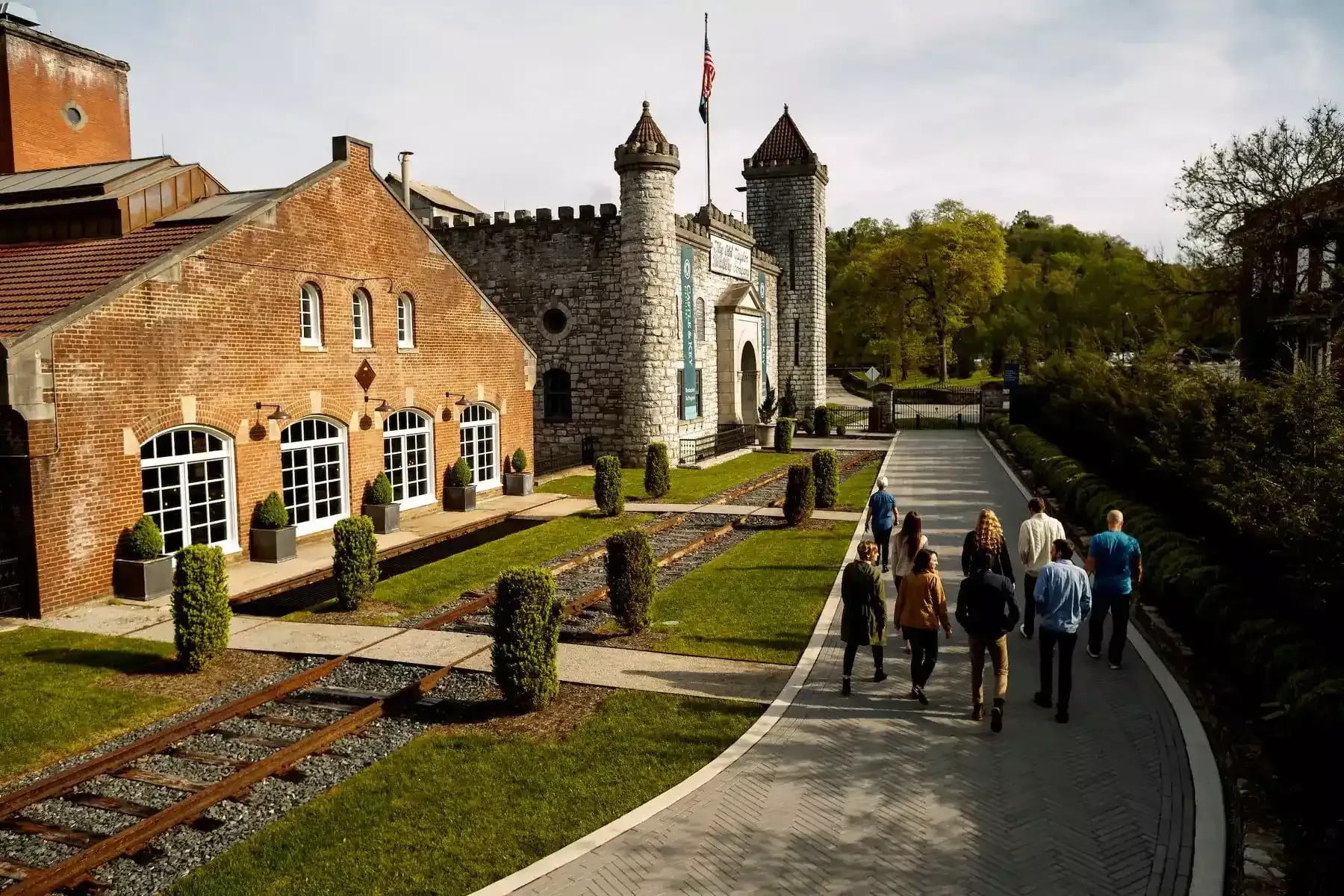
Castle & Key is the restored Old Taylor Distillery on McCracken Pike, near Frankfort. Colonel E.H. Taylor Jr. built it in 1887 with a limestone castle, a sunken garden and a springhouse over a limestone spring. Production stopped in 1972. New owners bought it in 2014 and reopened it to visitors in September 2018. Visiting details are in our Castle and Key distillery guide.
695 five-star reviews · Tripadvisor Travelers' Choice 2024, 2025, 2026 · 3,000+ private tours since 2012
Introduction to Kentucky’s Distilling History
Kentucky has been distilling for more than 200 years, and the Old Taylor site on McCracken Pike covers well over a century of that run, from 1887 to today.
The beginnings of Kentucky’s distilling history can be traced back to the late 1700s when settlers began experimenting with corn-based spirits. At this time, whiskey was seen as a way to preserve excess grain and provide an additional source of income for farmers. As production increased and demand grew, distillers started using different grains such as rye and barley to create new blends.
In the early 1800s, steamboat transportation became more prevalent which allowed for easier distribution of Kentucky’s distilled spirits beyond its borders. This led to an increase in popularity and profitability for the state’s distilleries.
One of the best-known names in Kentucky’s distilling history is Evan Williams, a distiller said to have started in Louisville in 1783, though historians doubt he was the first.
Another key factor in Kentucky’s rise as a leading producer of bourbon was its natural resources. The state has abundant limestone water sources which are essential for making good quality whiskey. Limestone acts as a natural filter, removing impurities from the water and giving it a high mineral content that adds distinct flavors to the final product.
During Prohibition (1920-1933), most Kentucky distilleries closed, and a few sold whiskey as medicine under federal permits.
After Prohibition was repealed, some distilleries reopened while others never recovered.
Today, Kentucky is home to well-known brands such as Jim Beam, Maker’s Mark, and Woodford Reserve. Kentucky distillers still work from the same core steps: a corn-heavy mash, fermentation, distillation and aging in new charred oak barrels. In our next section, we will explore how Castle & Key Distillery is playing a role in preserving this heritage while also bringing a modern twist to Kentucky’s distilling legacy.
History of Castle & Key Distillery
The history of Castle & Key Distillery dates back to the 19th century, when it was first established as the Old Taylor Distillery in 1887 by Colonel Edmund Haynes Taylor Jr. Known as the “father of modern bourbon,” Taylor was a prominent figure in Kentucky’s distilling industry and played a significant role in shaping its history.
Taylor built the Old Taylor Distillery with a limestone castle and formal gardens, because he wanted visitors to come.
Production stopped in 1972, and the once-thriving distillery sat abandoned for decades.
In 2014, new owners purchased the property with a vision to revive it and restore its legacy, and began extensive renovations on both the historic buildings and grounds.
The restoration process aimed to preserve as much of the original structures as possible. The iconic castle-like limestone buildings were restored with an emphasis on maintaining their historical integrity.
After four years of restoration, Castle & Key opened to visitors in September 2018. Today, tourists can take guided tours of the grounds, learn about Kentucky’s rich distilling history, and taste Castle & Key’s handcrafted spirits.
In addition to its historical significance, Castle & Key is also making a mark in the modern bourbon industry, with spirits that pay homage to Colonel Taylor’s legacy.
Castle & Key put a working distillery back on a site that sat silent from 1972 to 2014. That restoration story is why history-minded groups ask for it by name.
Tour and Tasting Experience at Castle & Key
At Castle & Key, visitors are not only able to witness the revival of Kentucky’s distilling history, but also indulge in a tour and tasting experience. The picturesque property, with its sprawling gardens and historic buildings, sets the perfect backdrop for a memorable visit.
The tour begins at the Visitor Center, where guests are greeted by friendly staff who explain the site's history and what it makes today. From there, visitors can take in the gardens and grounds.
Next up is a guided tour of the distillery itself, where visitors can witness first-hand how Castle & Key crafts its bourbon and gin. The knowledgeable guides explain each step of the process, from milling and mashing to fermentation and distillation, providing insight into what makes their spirits stand out from others in the market.
After exploring every nook and cranny of the distillery, guests have a chance to sample Castle & Key’s range of spirits while enjoying sweeping views of their serene surroundings.
The tour covers the Old Taylor story and the production floor, then closes with a tasting that typically includes bourbon, rye, and gin or vodka.
Behind the Scenes: Distilling Process at Castle & Key
The distilling process at Castle & Key, on one of Kentucky’s most iconic distillery sites, is a modern-day interpretation of traditional methods. Castle & Key makes bourbon, rye, gin and vodka on a campus built in 1887.
The first step in creating their spirits is the grain. This includes corn, rye, barley, and wheat, all vital components in producing high-quality bourbon.
Once the grains have been delivered to the distillery, they are then ground into a fine powder. This process allows for better extraction of flavors during fermentation. The milled grains are then mixed with water before being cooked to create what is known as “the mash.”
After cooking, yeast is added to the mash which initiates fermentation, a crucial step in creating bourbon. During this process, natural sugars are converted into alcohol over several days until a desired level of alcohol content is reached.
Next comes distillation, a method used to separate alcohol from other substances present in the fermented mash.
Once distilled, the clear liquid known as “white dog” is then placed into new charred oak barrels for maturation.
During maturation, the whiskey takes on color and flavor from the charred oak barrels through a process known as “breathing.” The whiskey expands into the wood during hot summer months before contracting during colder months, allowing for the infusion of flavors from the wood. This process can take anywhere from a few years to over a decade, depending on the desired flavor profile.
Once the whiskey has matured, it is then bottled and labeled with care. The distillery says its water comes from the same limestone spring Colonel Taylor built his 1887 springhouse over.
The behind-the-scenes distilling process at Castle & Key is a labor of love, where every step is carefully monitored and executed to create one-of-a-kind spirits. Castle & Key continues to revive and celebrate Kentucky’s distilling heritage through its products.
How we build a Castle & Key day
Castle & Key is closed on Monday and Tuesday and closes for weather at times, so we book it against your actual date and keep other stops in the cluster ready. We pair it with Buffalo Trace because one man links the two. Colonel Taylor owned what became Buffalo Trace before he built Old Taylor, so a Buffalo Trace morning and a Castle & Key afternoon tells his story in order. The campus also solves a common group problem. When one guest drinks bourbon and another prefers gin, Roots of Ruin Gin, Sacred Spring Vodka and the bar at Taylorton Station give everyone a pour. The springhouse is easy to rush past on the grounds walk, so we tell guests to stop there. Allow about 90 minutes on site.
Frequently asked questions
Is Castle & Key open every day?
No. Castle & Key is closed on Monday and Tuesday, and it closes for weather at times, so we book it against your actual date and keep other stops in the cluster ready. Allow about 90 minutes on site for the grounds walk, the tour of the production floor and the tasting at the end.
What does the Castle & Key tasting include?
The tour covers the Old Taylor story and the production floor, then closes with a tasting that typically includes bourbon, rye, and gin or vodka. That range helps mixed groups: guests who prefer clear spirits have Roots of Ruin Gin, Sacred Spring Vodka and the bar at Taylorton Station, while bourbon drinkers still get their pour.
Who built the Old Taylor Distillery?
Colonel Edmund Haynes Taylor Jr. built the Old Taylor Distillery in 1887 on McCracken Pike near Frankfort. He gave it a limestone castle, a sunken garden and a springhouse over a limestone spring, because he wanted visitors to come. Production stopped in 1972, new owners bought the property in 2014, and it reopened to visitors as Castle & Key in September 2018.
Can we visit Castle & Key and Buffalo Trace on the same day?
Yes, and we often pair them, because one man links the two. Colonel Taylor owned what became Buffalo Trace before he built Old Taylor, so a Buffalo Trace morning and a Castle & Key afternoon tells his story in order. Remember that Castle & Key is closed Monday and Tuesday. If Buffalo Trace matters to you, reach out at least 10 weeks ahead.
What should we not miss on the Castle & Key grounds?
The springhouse. It is easy to rush past on the grounds walk, so we tell guests to stop there. Colonel Taylor built it in 1887 over a limestone spring, and the distillery says its water still comes from that same spring. The gardens and the restored limestone castle are part of the same walk, so give the grounds time before the tasting.
Visit Castle & Key with BourbonTown Tours
We can build Castle & Key into a fully private tour: your group only, never mixed with strangers, with distillery tickets included.
BourbonTown Tours has run 3,000+ private tours since 2012. Every tour is private to your group, never mixed with strangers, and covers everything except lunch and driver gratuity. Distillery tickets are included.
Private tours run $275 to $425 per person depending on group size, plus 6% KY sales tax and a 3% booking fee.